

FMCG Market Set to Reach USD 1,800 Billion by 2035 as Sustainability E-Commerce & Consumer Wellness Reshape the Industry
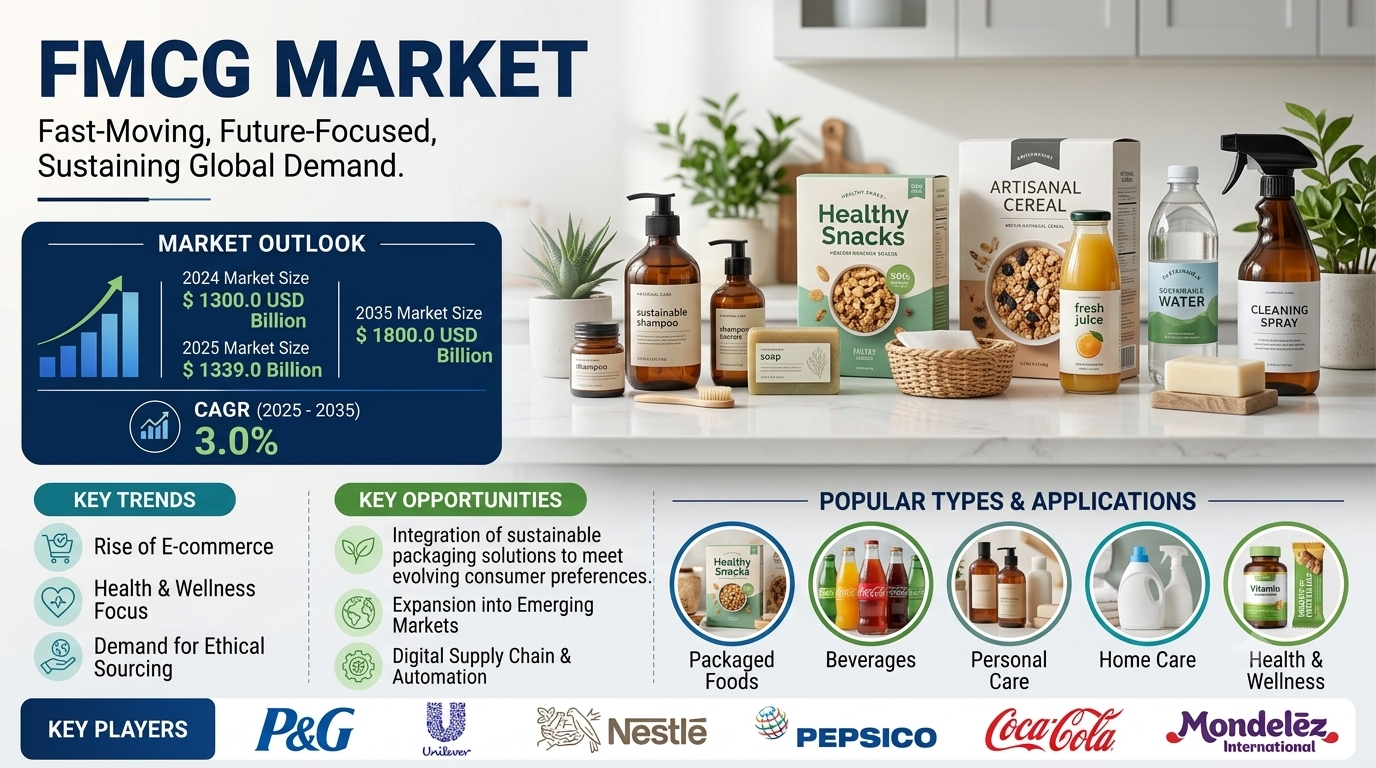
FMCG Market
FMCG trends are shifting toward wellness, sustainable packaging, convenience, digital shopping, and personalized consumer experiences worldwide.
The FMCG industry is evolving rapidly, shaped by changing consumer needs, innovation, digitalization, and rising demand for sustainable products.”
NEW YORK, NY, UNITED STATES, August 26, 2026 /EINPresswire.com/ -- The global Fast-Moving Consumer Goods (FMCG) Market is entering a period of steady transformation as changing consumer lifestyles, digital commerce, health awareness, convenience, and sustainability increasingly influence purchasing decisions. According to Market Research Future (MRFR), the global FMCG market was valued at USD 1,300.0 billion in 2024 and is projected to increase from USD 1,339.0 billion in 2025 to USD 1,800.0 billion by 2035, registering a 3.0% CAGR during 2025–2035. The industry is being reshaped by evolving consumption habits, greater digital engagement, sustainable product development, and continued innovation across food, beverages, personal care, household care, and healthcare products.— Market Research Future (MRFR)
The FMCG sector has traditionally depended on high-volume sales, strong distribution networks, recognizable brands, and efficient supply chains. However, the competitive environment is becoming more sophisticated. Consumers now have greater access to product information, online reviews, digital recommendations, and alternative brands. As a result, purchasing decisions are increasingly influenced not only by price and availability but also by ingredients, product functionality, packaging, brand purpose, sustainability credentials, and convenience.
Competitive Landscape:
The FMCG industry is characterized by intense competition among multinational corporations, regional manufacturers, emerging brands, and specialized players. Major companies highlighted in the MRFR report include:
▪️Procter & Gamble
▪️Unilever
▪️Nestlé
▪️PepsiCo
▪️Coca-Cola
▪️Mondelez International
▪️Johnson & Johnson
▪️Reckitt Benckiser
▪️and Danone.
Competition is evolving beyond traditional factors such as pricing and distribution. Companies are increasingly focusing on product innovation, sustainability initiatives, digital consumer engagement, efficient supply-chain management, health and wellness offerings, and products tailored to local preferences.
Large FMCG companies benefit from established brand recognition, extensive distribution networks, strong research and development capabilities, manufacturing scale, and substantial marketing resources. Meanwhile, smaller and emerging brands are gaining opportunities by responding quickly to changing consumer preferences, introducing niche products, and serving specialized market segments.
This dynamic competitive environment is encouraging continuous innovation and strategic differentiation. As consumer expectations continue to change, companies that effectively identify emerging trends and adapt their products, channels, and engagement strategies are better positioned to strengthen customer loyalty and capture new growth opportunities.
Future Outlook:
The FMCG industry is expected to maintain steady momentum through 2035, supported by the continued expansion of e-commerce, growing sustainability awareness, evolving consumer preferences, and ongoing product innovation. Companies are increasingly focusing on convenience, personalization, health-oriented offerings, and digitally enabled shopping experiences.
Future opportunities are likely to emerge through personalized nutrition products, direct-to-consumer platforms, sustainable packaging, digital retail channels, and innovative product formats. Businesses that combine technology, sustainability, and consumer-focused strategies are expected to strengthen their competitive position.
By 2035, the FMCG landscape is likely to become more dynamic and innovation-driven, with brands adapting their products, packaging, and distribution strategies to meet changing consumer expectations.
Get Full PDF Sample Copy of Report: (Including Full TOC, List of Tables & Figures, Chart) @
https://www.marketresearchfuture.com/sample_request/68205
Recent Developments in the FMCG Market:
The FMCG industry is experiencing steady transformation as manufacturers adapt to evolving consumer expectations, changing lifestyles, digital retail adoption, and increasing demand for differentiated products. Recent developments are encouraging companies to focus on product innovation, convenience, quality, and stronger consumer engagement.
A notable shift is the growing interest in natural, organic, and wellness-oriented products, encouraging brands to introduce offerings aligned with healthier and more conscious consumption habits. At the same time, premium and specialized product formats are gaining attention as consumers seek greater value and distinctive experiences.
The industry is also advancing through omnichannel retail and digital commerce, allowing consumers to access FMCG products through both traditional stores and online platforms. Alongside retail transformation, companies are investing in supply-chain modernization, improved inventory management, and technology-enabled operations to enhance efficiency.
Another important development is sustainable packaging and responsible production. Manufacturers are exploring recyclable, lightweight, and innovative packaging formats while responding to environmental concerns. Overall, the FMCG landscape is increasingly shaped by wellness, convenience, digitalization, sustainability, product differentiation, and consumer-focused innovation.
New Opportunities:
Packaging is both a necessity and a strategic opportunity for FMCG manufacturers. Beyond protecting products, effective packaging helps extend shelf life, support transportation, strengthen brand identity, and shape consumer purchasing decisions. As sustainability becomes increasingly important, packaging is emerging as a major area for product and process innovation. Manufacturers are exploring lightweight materials, recyclable structures, biodegradable alternatives, paper-based formats, refill systems, and designs that minimize material consumption. These approaches can help companies respond to changing consumer expectations while improving packaging efficiency across product categories.
Biodegradable and environmentally responsible packaging solutions are receiving growing attention as consumers, retailers, and regulators place greater emphasis on reducing environmental impact. Sustainable packaging can create opportunities for FMCG brands to differentiate themselves while supporting broader environmental goals. However, innovation must balance sustainability with functionality, affordability, safety, and convenience. Packaging for food, beverages, cosmetics, household products, and healthcare items must withstand transportation, storage, and handling requirements. As a result, successful packaging solutions will combine reduced environmental impact with durability, product protection, cost efficiency, and practical consumer-friendly designs. Transparent and credible environmental claims will also become increasingly important for maintaining consumer trust.
Market Segmentation:
By Product Type:
The FMCG sector is segmented into Beverages, Food, Personal Care, Household Care, and Health Care products, covering a broad range of everyday consumer needs.
By Packaging Type:
Based on packaging, the industry includes Plastic, Glass, Metal, Carton, and Flexible Packaging. Sustainability and convenience are increasingly influencing packaging preferences.
By Usage Frequency:
Products are categorized according to consumption patterns, including Daily, Weekly, Monthly, Occasional, and Seasonal usage. This segmentation reflects varying purchasing and consumption habits.
By Distribution Channel:
Key distribution channels comprise Supermarkets, Convenience Stores, Online Retail, Specialty Stores, and Wholesale. Digital commerce is expanding consumer access and purchasing convenience.
By Consumer Demographics:
Consumer segmentation considers factors such as Age, Income Level, Gender, Family Size, and Lifestyle. These characteristics help brands develop targeted products, pricing strategies, and marketing approaches.
FMCG Market Trends:
The FMCG industry is evolving with changing consumer lifestyles, digital adoption, and stronger interest in wellness and sustainability. Brands are focusing on healthier products, convenient formats, online retail, personalized marketing, and environmentally responsible packaging to meet emerging expectations.
Health and Wellness:
Demand for natural, organic, functional, and wellness-focused products is encouraging companies to introduce healthier formulations and clearer ingredient information.
Digital Transformation:
E-commerce, social media, AI, and data analytics are helping FMCG brands improve customer engagement, personalize marketing, and optimize purchasing experiences.
Sustainability:
Companies are adopting recyclable packaging, biodegradable materials, responsible sourcing, and resource-efficient practices as environmental awareness continues to influence purchasing decisions.
Regional Insights:
North America remains a key FMCG region, supported by strong consumer spending, advanced retail infrastructure, and growing demand for convenience, wellness-oriented products, and sustainable solutions. The United States represents the region’s largest market, while Canada and Mexico contribute to broader regional activity. E-commerce and omnichannel retail are reshaping purchasing habits, encouraging companies to strengthen digital sales and delivery capabilities. Europe also represents a mature and competitive landscape, where consumers increasingly favor organic, healthier, locally sourced, and environmentally responsible products. Germany, France, and the UK are important markets, with sustainability regulations influencing packaging, sourcing, labeling, and manufacturing practices. Leading brands are responding through recyclable packaging, transparent supply chains, product innovation, and improved digital engagement.
Asia-Pacific is emerging as an important growth center, driven by urbanization, rising household incomes, expanding retail networks, and changing lifestyles. China and India are major contributors, with consumers showing increasing interest in convenient, premium, health-focused, and regionally relevant products. E-commerce is also improving accessibility across urban and developing areas. Meanwhile, the Middle East and Africa offer expanding opportunities due to population growth, urban development, rising consumer spending, and improving retail infrastructure. South Africa, Nigeria, and the UAE are notable markets, while multinational and regional companies are adapting products to local preferences. Across these regions, innovation, affordability, digital commerce, sustainability, and consumer-centric strategies are expected to remain important factors shaping FMCG development.
Sustainability Becomes a Strategic Priority:
Sustainability is becoming an integral part of FMCG business strategies as consumers, retailers, and regulators place greater emphasis on environmental responsibility. Packaging is a major focus because FMCG products require solutions that provide protection, durability, convenience, and efficient transportation. While plastic remains widely used because of its flexibility and performance, brands are increasingly considering recyclable, biodegradable, paper-based, lightweight, and refillable alternatives. Packaging innovation is moving beyond simple material substitution toward solutions that reduce waste and support circular-economy practices.
Sustainable sourcing is also gaining importance across the FMCG value chain. Consumers are showing greater interest in ingredient origins, responsible production methods, ethical suppliers, and transparent supply chains. Companies are therefore investing in traceability, resource efficiency, responsible procurement, and improved supply-chain visibility. Sustainability can strengthen brand differentiation when environmental initiatives are combined with product quality, affordability, and convenience. At the same time, credible communication is essential, as consumers are becoming more attentive to environmental claims and expecting companies to demonstrate meaningful progress.
E-Commerce Accelerates FMCG Digital Transformation:
E-commerce is changing the way consumers discover, evaluate, purchase, and review everyday products. Digital platforms provide convenient access to extensive product ranges, detailed information, customer reviews, promotions, and home delivery options. This shift is encouraging FMCG companies to strengthen their online presence and develop strategies that connect digital engagement with purchasing opportunities.
Digital transformation is also influencing marketing and business decision-making. Brands are using social media, search marketing, influencer campaigns, loyalty programs, direct-to-consumer channels, and personalized recommendations to engage specific consumer groups. Data analytics and artificial intelligence can further support demand forecasting, inventory planning, customer insights, and personalized promotions. As consumers move between physical stores, mobile applications, websites, and delivery platforms, omnichannel strategies are becoming increasingly important for delivering consistent experiences across different retail environments.
Health and Wellness Influence Product Innovation:
Health and wellness priorities are increasingly influencing FMCG product development as consumers pay greater attention to nutrition, ingredients, personal care, and lifestyle choices. Food and beverage manufacturers are responding with functional products, plant-based alternatives, natural ingredients, reduced-sugar options, and formulations designed around specific dietary preferences. Personal care brands are also emphasizing ingredient transparency, simpler formulations, and wellness-oriented product benefits.
This shift is creating opportunities for established manufacturers as well as specialized and emerging brands. Companies are placing greater emphasis on clear product information, educational content, transparent sourcing, and credible benefit communication. Digital channels provide an effective way to explain ingredients, product applications, and usage benefits while building stronger consumer relationships. Brands that successfully combine health-oriented positioning with taste, quality, affordability, and convenience can improve their appeal across increasingly informed consumer segments.
Convenience Continues to Shape Product Formats:
Convenience remains a major influence on FMCG consumption as consumers seek products that save time and simplify everyday activities. Ready-to-eat foods, packaged snacks, portable beverages, easy-open packs, compact household products, and multifunctional personal care solutions are examples of formats designed around busy lifestyles. Packaging is also evolving to improve portability, storage, opening, dispensing, and overall usability.
Convenience increasingly extends beyond the product itself to the entire purchasing journey. Online grocery services, quick-commerce platforms, subscriptions, digital payments, loyalty programs, and doorstep delivery are making FMCG purchasing faster and more accessible. Companies that combine convenience with affordability, quality, health, and sustainability can better address changing expectations. Continued innovation in product formats, packaging, retail experiences, and digital services is expected to keep convenience at the center of FMCG strategies.
Frequently Asked Questions?
1. What is the projected size of the FMCG market by 2035?
The global FMCG market is projected to reach approximately USD 1,800.0 billion by 2035, compared with USD 1,300.0 billion in 2024. The industry is forecast to expand at a CAGR of 3.0% between 2025 and 2035.
2. What are the major factors influencing the FMCG industry?
Major influences include increasing e-commerce adoption, health and wellness awareness, sustainability preferences, demand for convenience, technological advancement, changing demographics, and urbanization.
3. Why is sustainable packaging important for FMCG companies?
Sustainable packaging can help companies respond to consumer environmental concerns, reduce material impacts, support evolving regulatory expectations, and differentiate products in a competitive retail environment.
4. Which companies are prominent in the FMCG sector?
Major companies profiled in the report include Procter & Gamble, Unilever, Nestlé, PepsiCo, Coca-Cola, Mondelez International, Johnson & Johnson, Reckitt Benckiser, and Danone.
Discover More Research Reports By Market Research Future:
India FMCG Market:
https://www.marketresearchfuture.com/reports/india-fmcg-market-12520
US FMCG Market:
https://www.marketresearchfuture.com/reports/us-india-fmcg-market-20994
Home Furniture Market:
https://www.marketresearchfuture.com/reports/home-furniture-market-21818
Argan Oil Market:
https://www.marketresearchfuture.com/reports/argan-oil-market-3752
Coin Collecting Market:
https://www.marketresearchfuture.com/reports/coin-collecting-market-22623
Market Research Future
Market Research Future
+1 855-661-4441
email us here
Legal Disclaimer:
EIN Presswire provides this news content "as is" without warranty of any kind. We do not accept any responsibility or liability for the accuracy, content, images, videos, licenses, completeness, legality, or reliability of the information contained in this article. If you have any complaints or copyright issues related to this article, kindly contact the author above.
